The atopic dermatitis-like lesion and the associated MRSA infection and barrier dysfunction can be alleviated by 2,4-dimethoxy-6-methylbenzene-1,3-diol from Antrodia camphorata
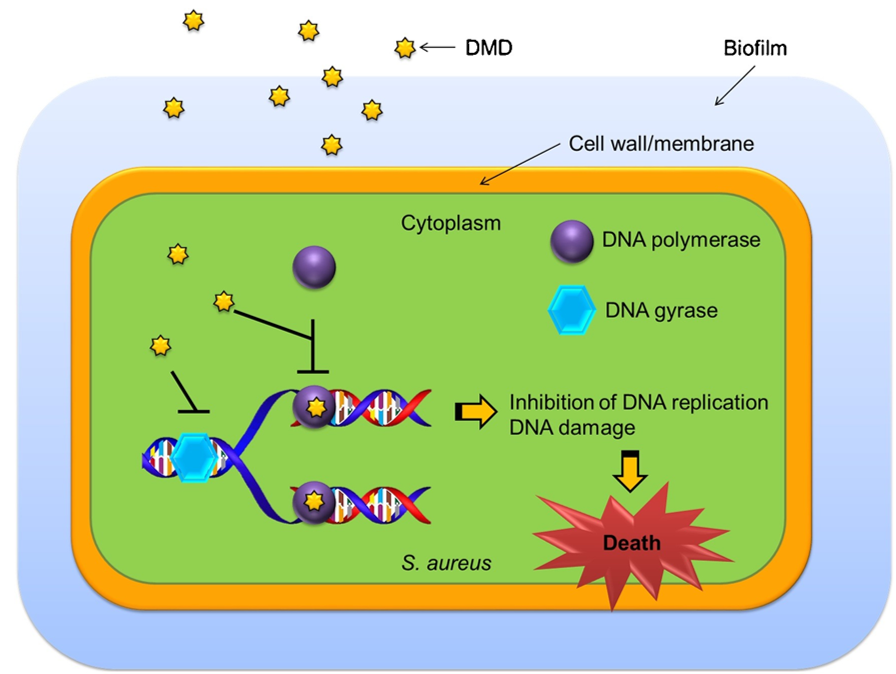
圖文摘要說明
本研究探討從牛樟芝中分離出的化合物 DMD (2,4-dimethoxy-6-methylbenzene-1,3-diol) 對於治療異位性皮膚炎的潛力。示意圖顯示,DMD (黃色星形) 不僅能有效抑制抗藥性的金黃色葡萄球菌 (MRSA),其機制可能涉及干擾細菌的 DNA 複製過程;同時,DMD 還能促進皮膚角質細胞分化、恢復皮膚屏障蛋白(如絲聚蛋白)的表現,從而修復皮膚屏障功能,達到兼具抗菌與修復的雙重治療效果。
Abstract
Background: Atopic dermatitis (AD) is an inflammatory skin disease with an associated barrier dysfunction and Staphylococcus aureus infection. The mainstay steroid and calcineurin inhibitor therapy shows some adverse effects. 2,4-Dimethoxy-6-methylbenzene-1,3-diol (DMD) is a benzenoid isolated from Antrodia camphorata. Objective: We investigated the inhibitory effect of DMD on methicillin-resistant S. aureus (MRSA), the chemokine production in stimulated keratinocytes, and the AD-like lesion found in ovalbumin (OVA)-sensitized mice. Methods: The antimicrobial effect and cutaneous barrier function were evaluated using an in vitro culture model and an in vivo mouse model of AD-like skin. Results: DMD exhibited a comparative minimum inhibitory concentration (MIC) and minimum bactericidal concentration (MBC) against MRSA with nalidixic acid, a conventional antibiotic. The MIC and MBC for DMD was 78.1 and 156.3 μg/ml, respectively. DMD also showed the ability to eliminate the clinical bacteria isolates with resistance to methicillin and vancomycin. The DNA polymerase and gyrase inhibition evoked by DMD for bacterial lethality was proposed. In the activated keratinocytes, DMD stopped the upregulation of chemokines (CCL5 and CCL17) and increased the expression of differentiation proteins (filaggrin, involucrin, and integrin β-1). Topical application of DMD facilely penetrated into the skin, with AD-like skin displaying 2.5-fold greater permeation than healthy skin. The in vivo assessment using the mouse model with OVA sensitization and MRSA inoculation revealed a reduction of transepidermal water loss (TEWL) and bacterial burden by DMD by about 2- and 100-fold, respectively. Differentiation proteins were also restored after topical DMD delivery. Conclusion: Our data demonstrated an advanced concept of AD treatment by combined barrier repair and bacterial eradication with a sole agent for ameliorating the overall complications.
Keywords: 2,4-dimethoxy-6-methylbenzene-1,3-diol; Antrodia camphorata; Atopic dermatitis; Bacterial infection; Barrier function
瀏覽數: