Encapsulation of β-Glucosidase within PVA Fibers by CCD-RSM-Guided Coelectrospinning: A Novel Approach for Specific Mogroside Sweetener Production
圖文摘要說明
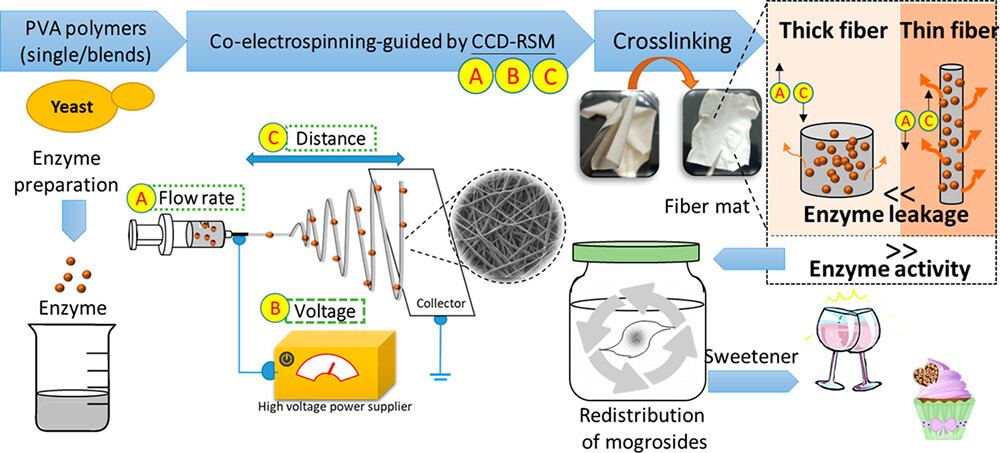
為了生產一種來自羅漢果的稀有天然甜味劑「Siamenoside I」,一項研究開發了一套創新的生物製造流程,其核心是先建構一種能生產特定β-葡萄糖苷酶的酵母菌,利用此酵素將常見的前驅物「羅漢果苷V」轉化為目標產物。如圖所示,為實現酵素的重複利用,研究人員將此酵素與聚乙烯醇(PVA)高分子材料,透過「共靜電紡絲」技術製成奈米纖維薄膜,並利用反應曲面法(RSM)來優化流速、電壓等紡絲參數,最後進行交聯處理以增強穩定性。研究發現,被固定化的酵素不僅穩定性提高,其活性更與纖維直徑呈現正相關(即粗纖維活性高、洩漏少),最終在批次生產中展現了高效的Siamenoside I轉化率,為天然甜味劑的工業化應用提供了新穎的解決方案。
Abstract
Siamenoside I is a rare mogroside in Siraitia grosvenorii Swingle and has become one of the target ingredients in natural sweetener production. However, the complex structure of siamenoside I has hindered its production in various ways. Here, a yeast cell that produces a specific β-glucosidase for siamenoside I conversion from mogroside V was constructed, and the enzymes were coelectrospun with poly(vinyl alcohol) followed by phenylboronic acid cross-linking to provide potential usage in the batch production process of Siamenoside I. A central composite design (CCD)-response surface methodology (RSM) was used to find the optimum coelectrospinning parameters. The pH stability and sodium dodecyl sulfate tolerance increased for the entrapped enzymes, and positive correlations between the fiber diameter and enzymatic activity were confirmed. The batch process showed an average siamenoside I production rate of 118 ± 0.08 mg L-1 h-1 per gram of fiber. This is the first research article showing specific siamenoside I production on enzyme-loaded electrospun fibers.
Keywords:Siamenoside I; β-Glucosidase; Poly(Vinyl Alcohol); Coelectrospinning; CCD-RSM
瀏覽數: