Valorization of Lemon Processing By-Products Through Multi-Strain Fermentation: Strain-Specific Changes in Flavonoids, Limonoids, and Antioxidant Capacity
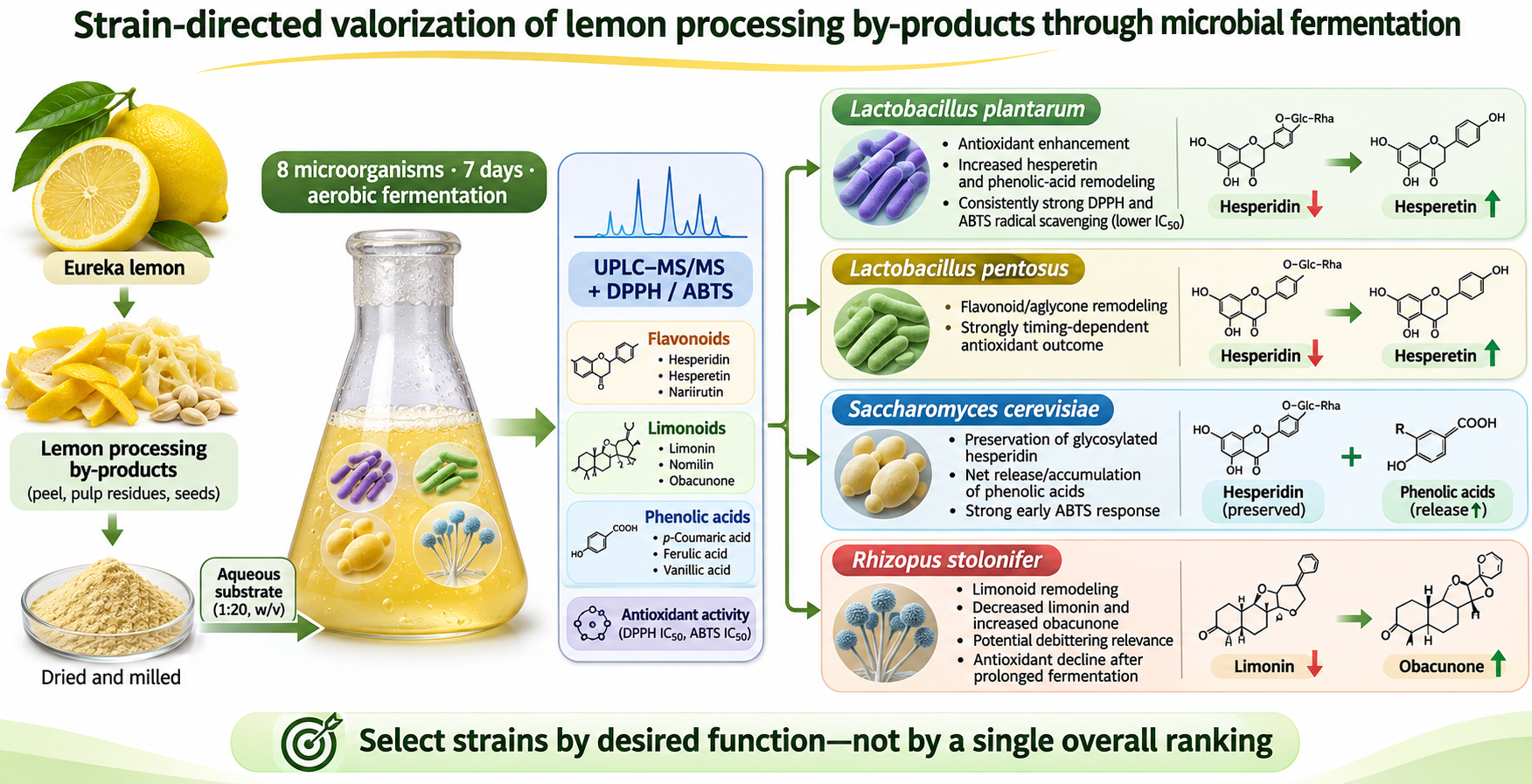
圖文摘要說明
本圖以概念方式呈現八種微生物發酵檸檬加工副產物後,類黃酮、檸檬苦素類、酚酸及抗氧化活性的變化。研究結果顯示,不同菌株具有不同的功能特性:植物乳桿菌有助於提升抗氧化活性,戊糖乳桿菌促進類黃酮轉化,釀酒酵母有助於保留醣苷型類黃酮及釋出酚酸,匍枝根黴則具有降低檸檬苦素含量的潛力。
註:本圖為使用 ChatGPT 參考研究內容生成之概念示意圖,非原論文刊載圖片。圖示內容尚未逐項驗證,僅供輔助理解,詳細研究結果請以原始論文為準。
Abstract
Lemon processing by-products are rich in flavonoids, limonoids, and phenolic acids, but their direct utilization is limited by glycoside-dominant flavonoid profiles, bitterness-associated limonoids, and insufficiently defined valorization strategies. This study compared eight food-relevant microorganisms, including lactic acid bacteria, Bacillus, yeast, and filamentous fungi, using a common aerobic submerged fermentation framework for lemon by-products. Rather than evaluating fermentation as a single uniform process, the study aimed to determine whether different microbial groups could redirect the same substrate toward distinct functional remodeling profiles. Targeted HPLC analysis of flavonoids, limonoids, and phenolic acids, together with DPPH and ABTS radical-scavenging assays, revealed clear strain-dependent differences in metabolite remodeling and antioxidant outcomes. L. plantarum showed the most consistent antioxidant enhancement profile, characterized by increased hesperetin and phenolic acid responses together with low DPPH and ABTS IC50 values. L. pentosus promoted flavonoid remodeling but showed a more timing-sensitive antioxidant response. S. cerevisiae tended to preserve glycosylated flavonoids and showed a release-oriented phenolic acid profile with strong early ABTS activity. R. stolonifer exhibited the most pronounced limonoid remodeling, including marked limonin reduction and obacunone accumulation, suggesting potential relevance for bitterness-oriented applications. These findings demonstrate that different microorganisms can be functionally classified according to their dominant remodeling tendencies, including antioxidant enhancement, flavonoid conversion, glycosylated flavonoid preservation, phenolic acid release, and limonoid-associated debittering. This functional classification provides a practical basis for selecting microorganisms according to the intended application of lemon by-product valorization.
Keywords: lemon by-products; microbial fermentation; metabolic conversion; strain selection; flavonoids; limonoids; antioxidant activity
瀏覽數: